1100 mAh on Your Wrist: Meet the New Gelius Amazwatch Energy
A Smartwatch Can Do a Lot. But It All Starts with the Charge
It is easy to evaluate the capabilities of a modern smartwatch by the number of functions. What kind of display does it have? Can you answer calls? How many sports modes are there? Is heart rate monitoring available? And what about notifications, weather, music, and other smart tools?
But the more actively we use all of this, the more tasks the battery has to handle at the same time.
A bright screen needs power. Always On Display keeps information available on the display. Bluetooth maintains a wireless connection with the smartphone. Calls use the microphone and speaker. Workouts and wellness functions use the watch's capabilities to collect and display data.
That is why one of the characteristics that is easy to underestimate when choosing a smartwatch is its battery capacity.
And the new Gelius Amazwatch Energy begins its introduction with a number that is hard not to notice.
1100 mAh.
That is the battery capacity installed in this model. But it is not only the number itself that attracts attention. Another question is much more important: why does a smartwatch need such a battery, and what does Amazwatch Energy offer besides it?
This is where the real introduction to the new model begins.
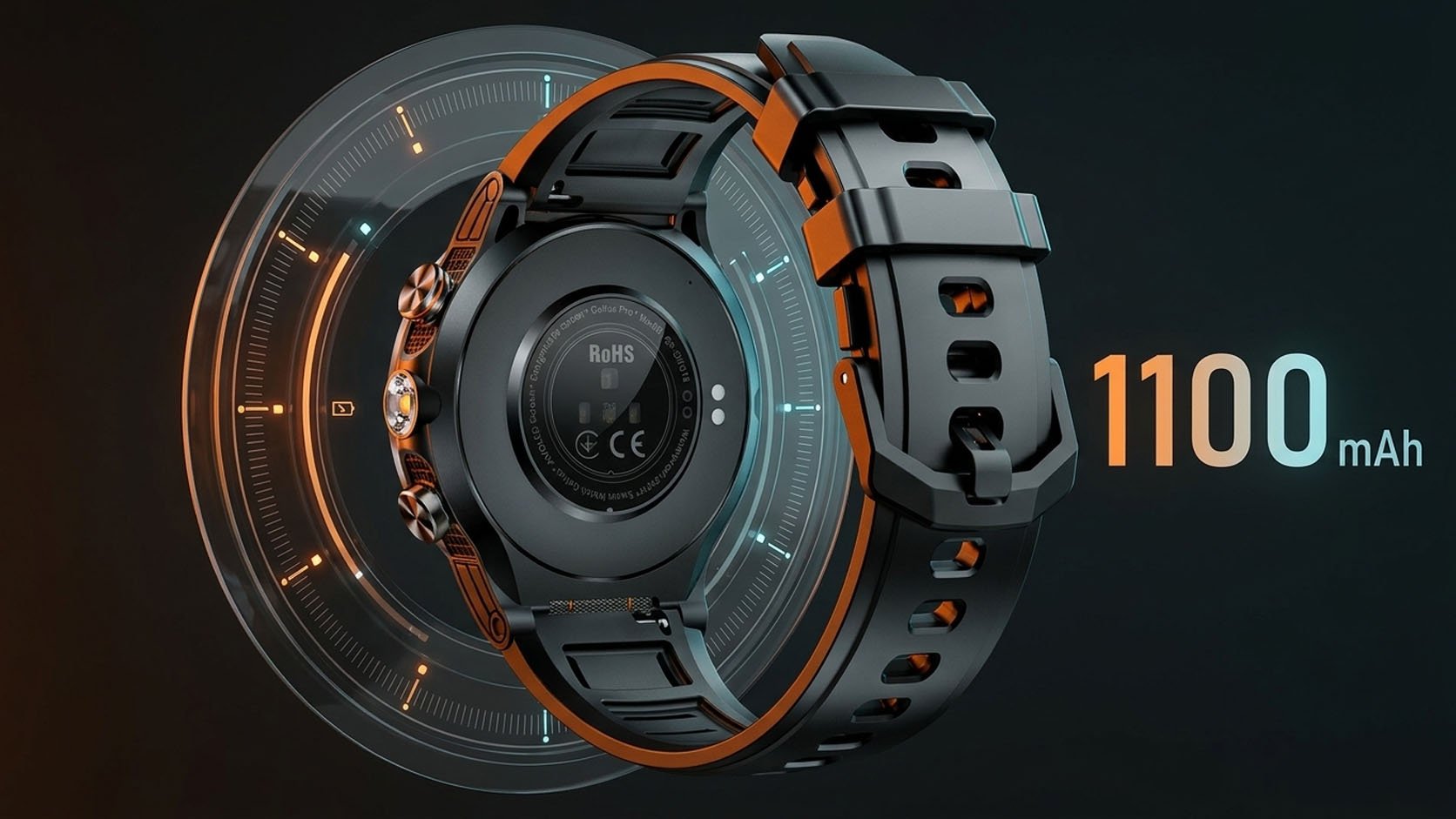
1100 mAh — the Main Number of the New Amazwatch Energy
A smartwatch is one of those gadgets that can work together with the user practically throughout the entire day. In the morning, it shows the time and data after sleep, on the way it delivers notifications, during the day it helps track activity, and in the evening it can accompany a workout or a walk.
That is why the battery in such a device powers not one individual function, but an entire system.
In Gelius Amazwatch Energy, this includes the AMOLED display and Always On Display, Bluetooth 5.4, calls through the watch, notifications, sports modes, indicator monitoring, digital compass, smart functions, and a separate LED flashlight.
It is in this context that the 1100 mAh battery looks most interesting.
It is not just a large number that can be placed on the box. It is the energy foundation of the model's capabilities.
At the same time, the manufacturer does not specify a particular number of days of battery life for Amazwatch Energy in the provided description. And this is an important point: turning the battery capacity into invented "10," "20," or "30 days" would be incorrect.
The actual operating time of a smartwatch depends on exactly how it is used: which functions are active, how often the display works, whether AOD is used, how many notifications arrive, and how often calls and workouts take place.
Therefore, in the case of Amazwatch Energy, 1100 mAh is better understood not as a promise of a specific number of days, but as a large energy reserve for a feature-rich watch.
Not Charging for the Sake of Charging, but Using the Functions
There is a certain paradox: we choose a smart device because of its capabilities, and then we may start saving battery by turning off the very functions we needed it for.
Always On Display is convenient because it allows you to see the necessary information. Notifications are needed so you don't have to check your smartphone after every signal. Bluetooth calls are useful so that in certain situations you can talk through the watch. Sports modes make sense precisely when we use them during a workout.
That is why a large battery looks logical specifically in a model with many usage scenarios.
This does not mean that 1100 mAh makes the charge infinite or guarantees the same battery life for all users. But the concept itself is clear: the energy reserve should support the capabilities of the device rather than exist as a separate number in a specifications table.
And one of the most noticeable functions that needs this energy every day is right in front of your eyes.
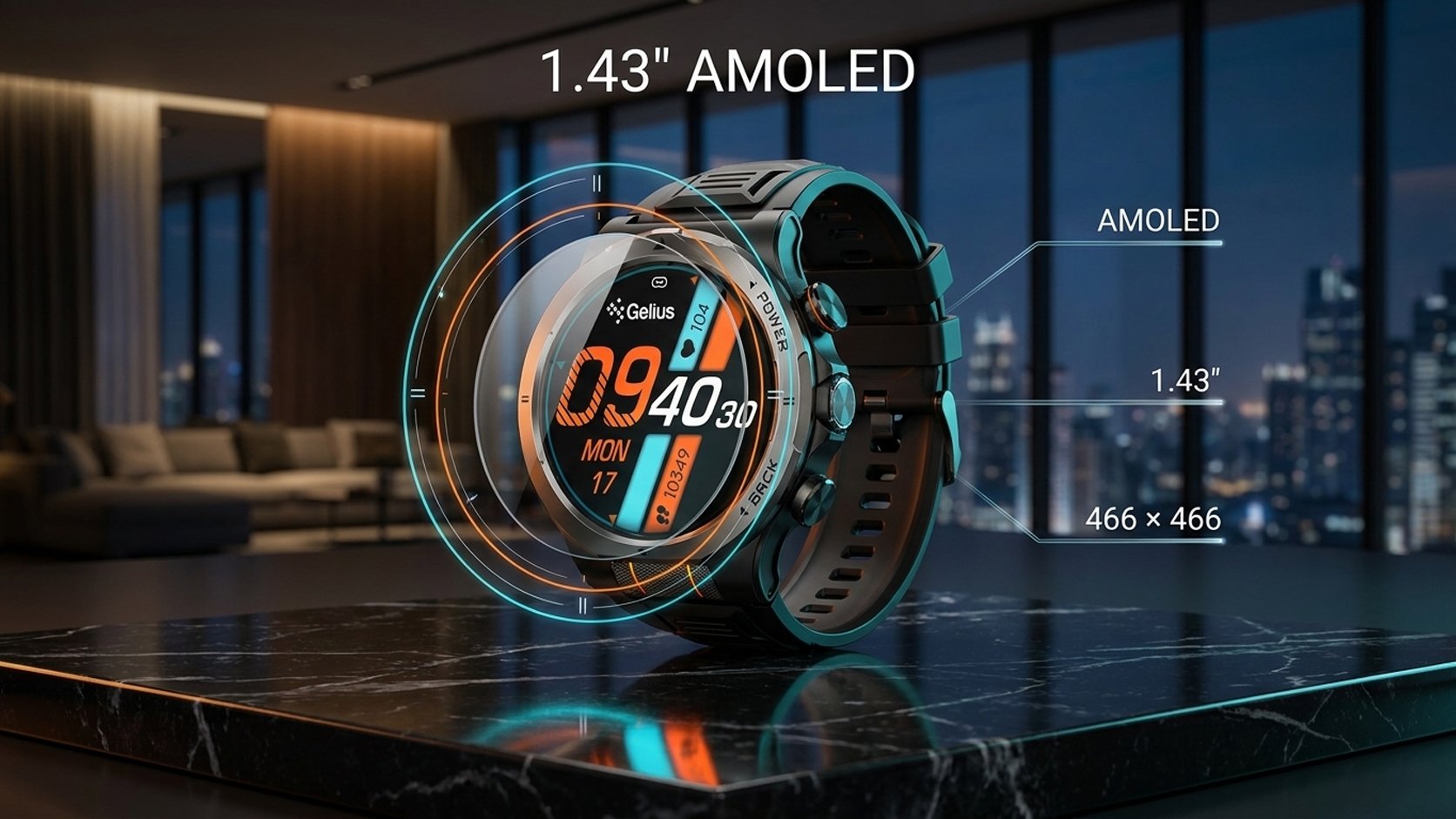
1.43" AMOLED — a Screen You Want to Use
Gelius Amazwatch Energy is equipped with a round 1.43-inch AMOLED display with a resolution of 466 × 466 pixels.
The display is touch-sensitive and becomes the main interface for most everyday interactions with the watch.
This is where the user sees the time, moves between menu items, reads notifications, interacts with call functions, views sports indicators, or checks the weather.
The model also supports Always On Display.
AOD allows the necessary information to remain visible without having to fully activate the display every time you quickly glance at the watch.
This is where the connection between the specifications becomes apparent. AMOLED and AOD are functions you want to use, while the 1100 mAh battery creates the energy foundation for such a feature-rich scenario.
At the same time, there is no point in attributing parameters to the display that the manufacturer does not specify. To get acquainted with the model, it is enough to know exactly what has been stated: AMOLED, a 1.43" diagonal, 466 × 466 resolution, and Always On Display support.
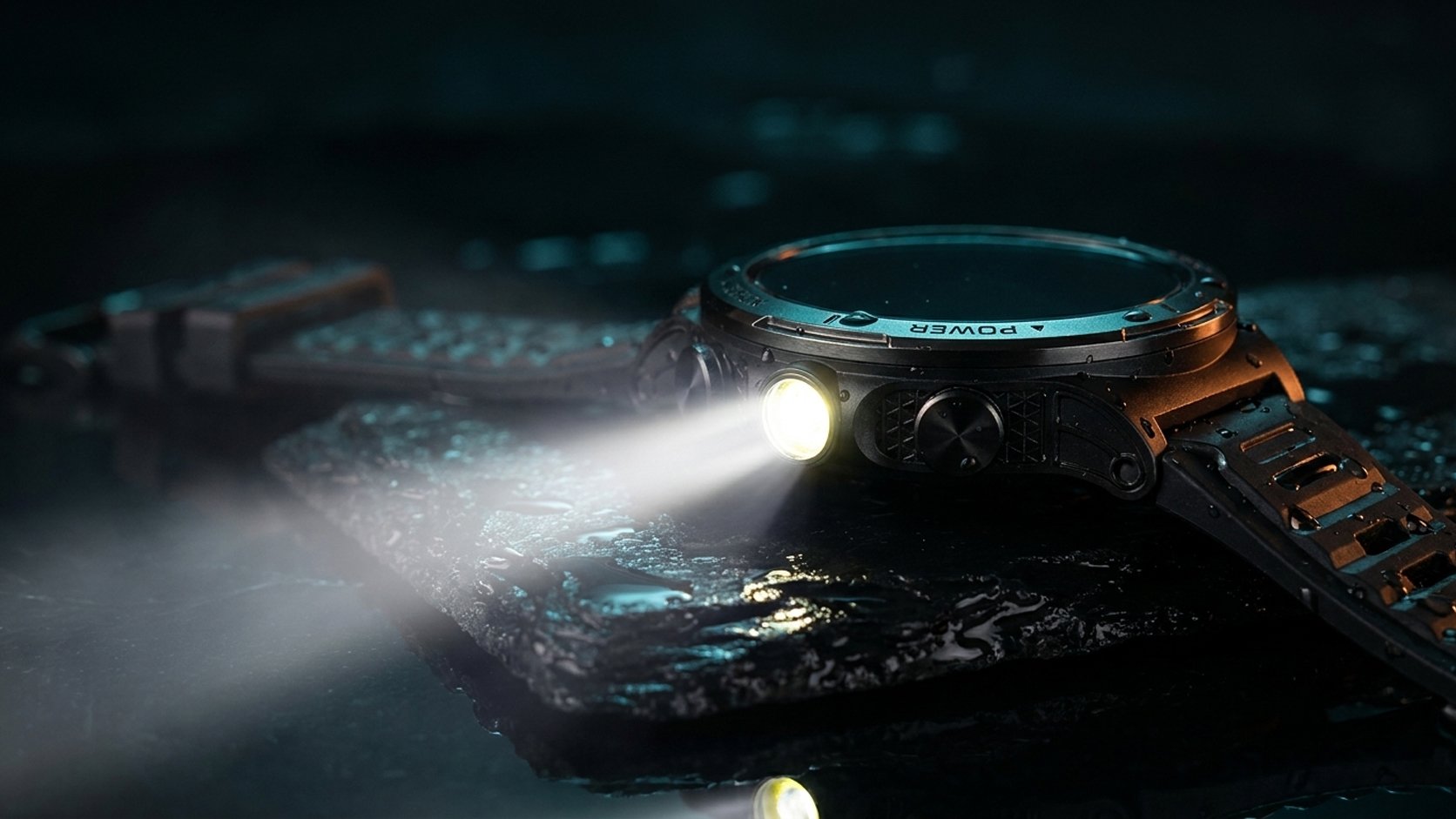
A Real Flashlight on Your Wrist
If 1100 mAh is the main number of Amazwatch Energy, then one of its most unusual practical functions is hidden on the side of the case.
It is a separate LED flashlight.
In other words, this is not a mode in which the watch display simply turns white and is used as a light source. A separate LED element is built into the side of the case.
Three modes are specified for the flashlight:
- bright directional light;
- flashing;
- emergency signal.
And real-life situations best explain why a flashlight is needed in a smartwatch at all.
You may need to illuminate the path ahead during an evening walk. Find an item in the dark. See a keyhole or the object you need in a dark entrance. Find your way during a power outage. Get an additional light source while camping or during outdoor activities.
In most of these situations, you can use a smartphone. But first, you need to find it in your pocket or bag, take it out, and turn on the flashlight.
Amazwatch Energy is already on your wrist.
And that is why the separate LED flashlight looks not simply like an impressive feature in the specifications list, but like a function for which it is quite easy to imagine a real-life scenario.
A Watch That Doesn't Ask to Be Left at Home
The functionality of a smartwatch matters only when the device itself is ready to accompany the user in different situations.
Gelius Amazwatch Energy is made with a metal case, a round shape, and a black design. The model is also specified as having a shock-resistant design.
The appearance of the watch fits its overall concept well. The large round display, metal case, and distinctive physical controls create the image of a device designed not only for calm use at a work desk.
This does not mean that the watch is "impossible to break" or that it will withstand any fall. A shock-resistant design should not be turned into a promise of absolute invulnerability.
But combined with the stated water protection, this design expands the everyday usage scenarios of Amazwatch Energy.
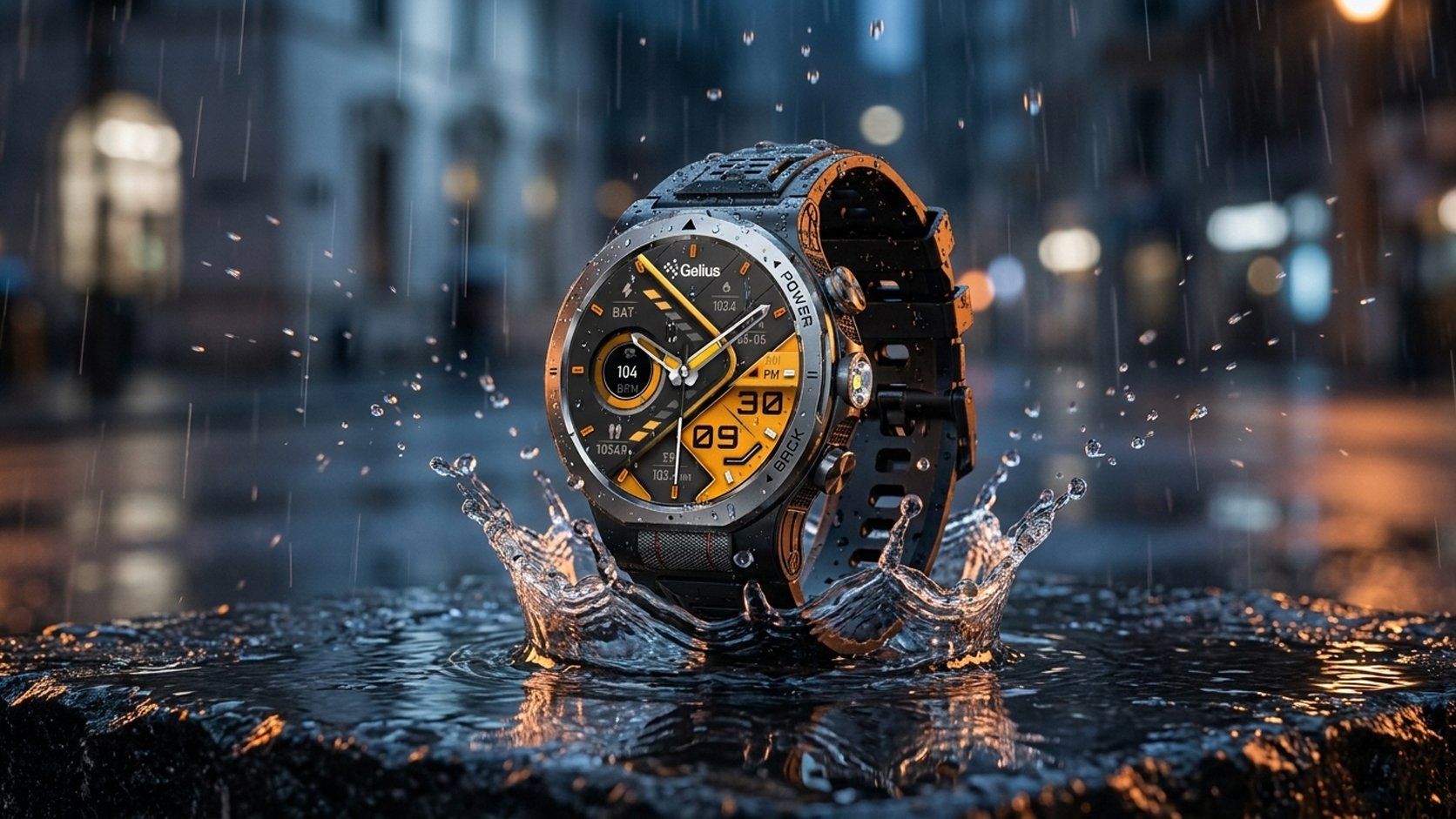
3ATM / IPX8 — When Water Shouldn't Stop Your Day
Gelius Amazwatch Energy is specified with 3ATM / IPX8 protection.
According to the manufacturer's official description, the model is designed for contact with water, including during rain, showering, and swimming.
This is important specifically in the context of everyday wear. If the watch is used for notifications, activity, workouts, and other functions throughout the day, ordinary contact with water should not automatically mean that the device needs to be put aside.
At the same time, the stated protection capabilities should not be independently expanded. Diving, deep-water immersion, sauna use, or exposure to hot water are not scenarios that should be added without a direct statement from the manufacturer.
Within the stated conditions, the logic is simple: Amazwatch Energy is designed as a watch that can remain on your wrist in different everyday situations.
Smartphone in Your Pocket — Call on Your Wrist
Another reason not to constantly take out your phone is the ability to work with calls directly through the watch.
Gelius Amazwatch Energy uses Bluetooth 5.4 and is equipped with a built-in microphone and speaker.
The model supports receiving and making calls. In an everyday scenario, this can be convenient when the smartphone is in a bag, lying on a table, or is simply inconvenient to hold in your hands.
The watch also allows you to receive notifications from apps and messengers.
This does not mean that Amazwatch Energy should replace a smartphone. The logic is different: the phone remains nearby and continues to be the main device, but for some brief everyday interactions, you do not need to take it out every time.
See a notification. Check who is calling. When needed, answer a call through the watch. And continue with what you were doing.
The Workday Is Over — Amazwatch Energy Keeps Tracking Activity
The workday may end at 6:00 PM, but for a smartwatch this does not necessarily mean the end of its work.
In the evening, another scenario begins — activity and workouts.
Gelius Amazwatch Energy supports sports modes for different types of activities. Among the available scenarios are running, cycling, swimming, yoga, boxing, and other workouts.
And here it is more important not to list as many modes as possible, but to understand that users can be completely different.
One person needs a smartwatch for sports to accompany morning or evening runs. Another rides a bicycle more often. Someone works out at the gym, while someone else prefers yoga or swimming.
In each case, the watch moves from office notifications and calls to a completely different task — accompanying physical activity.
And this is another example of why the concept of a large battery makes sense here: throughout the day, it is not the device that changes, but the ways it is used.
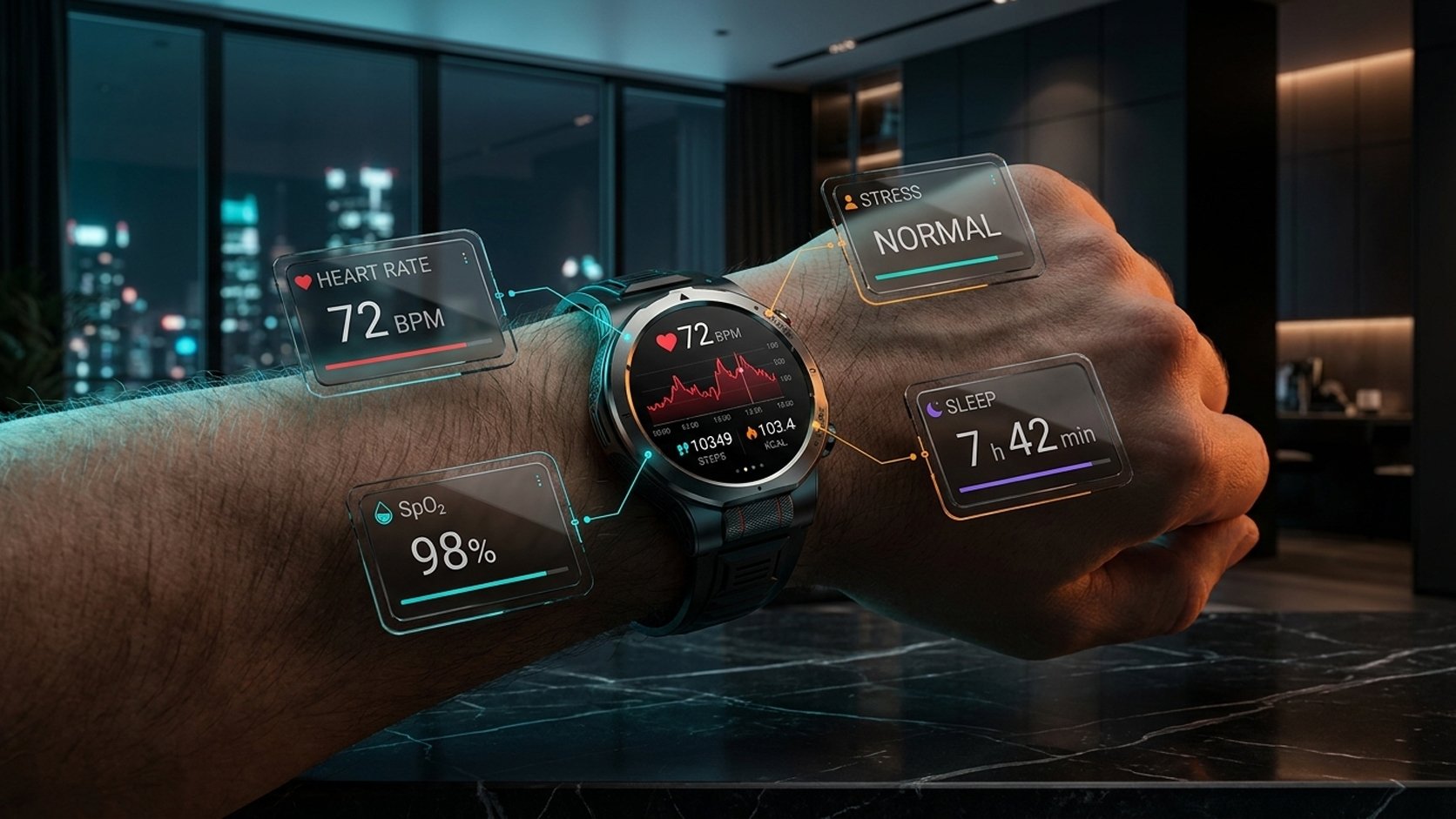
Heart Rate, SpO2, Stress, and Sleep — More Data About Your Day
In addition to sports modes, Gelius Amazwatch Energy offers a set of wellness functions for observing indicators throughout the day and night.
The model includes:
- heart rate monitoring;
- SpO2;
- stress level monitoring;
- sleep analysis.
These capabilities help collect more data about your own activity and observe changes in indicators in different situations.
For example, the watch can be used to observe heart rate, view available SpO2 data, assess stress indicators, or analyze sleep information.
But it is important to correctly understand the purpose of these functions. Amazwatch Energy should not be considered a medical device, and the obtained indicators should not be treated as a diagnosis of diseases.
These are wellness functions for observing indicators and their dynamics, not a replacement for professional medical measurements or a doctor's consultation.
A Physical Crown Instead of Endless Swipes
The AMOLED display of Amazwatch Energy is touch-sensitive, but interaction with the watch is not limited to touching the screen.
The case features a textured rotating crown.
It can be used to scroll through menus and settings, adding a physical method of navigation to touch controls.
This is a small detail compared with the battery, display, or flashlight, but these are exactly the kinds of elements that affect everyday interaction with the device. Not every action necessarily has to be performed with a series of swipes across the screen.
Compass, Music, Camera, and a Few More Reasons Not to Take Out Your Smartphone
Some of the Amazwatch Energy capabilities do not require a separate large section, but together they form another layer of everyday functionality.
The watch includes a digital compass, which complements scenarios involving walks and outdoor activities.
Other stated capabilities include weather forecast, music control, and smartphone camera control.
The set of everyday tools also includes an alarm clock, timer, stopwatch, and "Find Phone" function.
A 3D menu is also provided for interaction with the interface.
Individually, each of these functions may seem small. But their usefulness becomes apparent throughout the day: check the weather before leaving, switch music, start a timer, use the stopwatch, or find a smartphone that was left somewhere nearby.
And once again, the same logic applies: the watch does not replace the phone but takes over some brief interactions for which you do not always want to take out your smartphone.
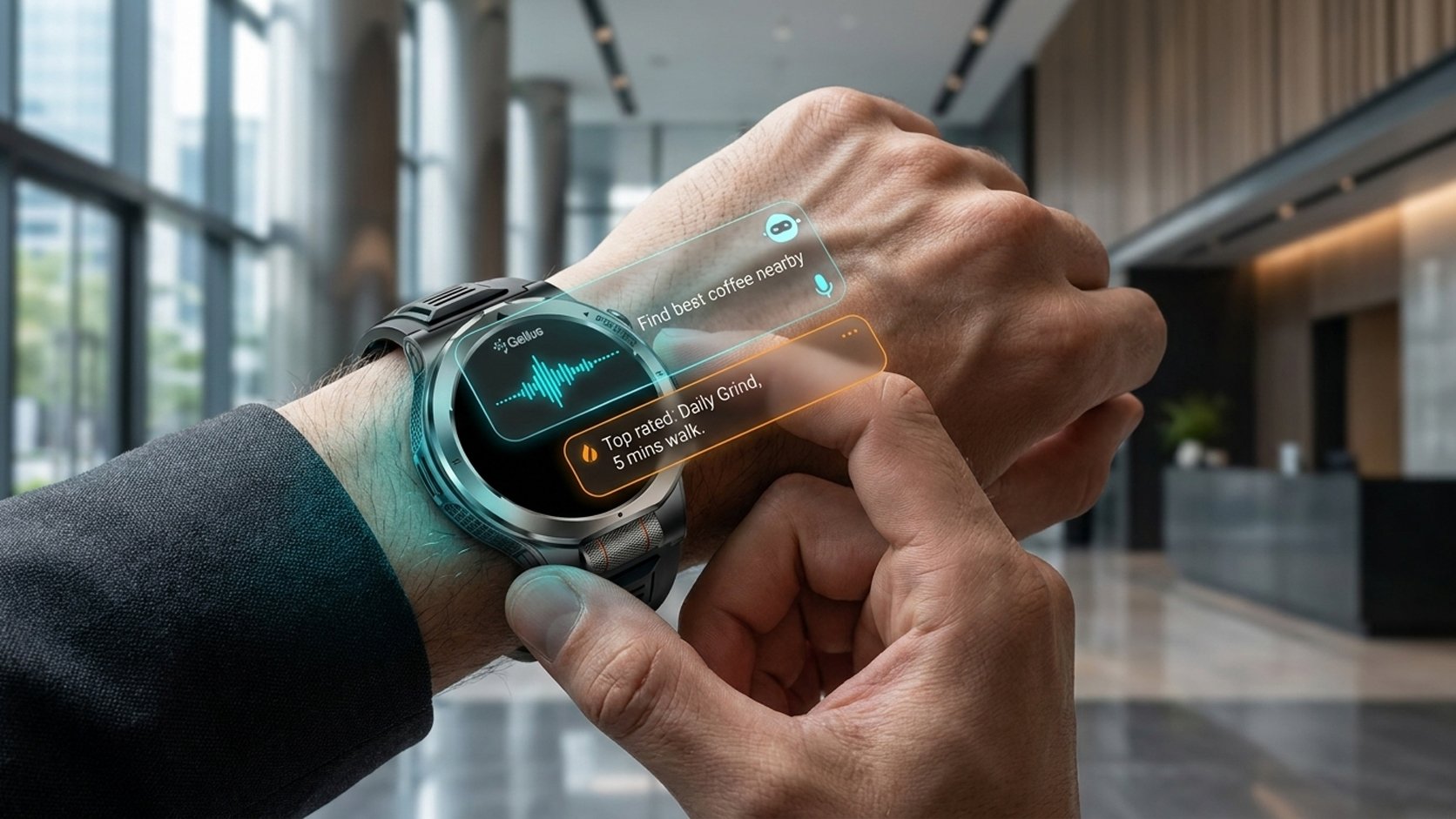
What About AI?
Among the capabilities of Gelius Amazwatch Energy, AI functions and a voice assistant are also stated.
This complements the set of smart capabilities of the new model, but it would be incorrect to attribute specific AI mechanisms to the watch that the manufacturer does not describe.
Therefore, this characteristic should not automatically be interpreted as the presence of ChatGPT directly in the watch, a separate autonomous AI model, or content generation functions.
In the context of getting to know Amazwatch Energy, it is enough to note what is stated for the model: support for AI functions and a voice assistant.
Who Actually Needs 1100 mAh on Their Wrist
It is easy to turn a large battery into an abstract advantage: the more mAh, the more interesting the specification looks. But it is much more useful to ask another question — in which scenarios can the Amazwatch Energy's energy reserve be especially appropriate?
First of all, the model is worth considering for those who actively use the capabilities of a smartwatch rather than limiting themselves to checking the time a few times a day.
If you use Always On Display, read notifications, use Bluetooth calls, and regularly interact with the screen, the watch performs significantly more tasks throughout the day.
The second scenario is workouts and activity. Running, cycling, swimming, gym sessions, or other sports modes add another major set of functions to everyday use.
The third is the desire to think less about the charging process itself and use more of the device's capabilities. At the same time, it is important to emphasize once again: 1100 mAh does not provide grounds to independently promise a specific number of days of battery life. But the large battery capacity is one of the model's central design characteristics.
The fourth scenario is users who appreciate practical, unconventional functions. The separate LED flashlight is a good example. It is not needed every minute, but in a dark entrance, on an evening walk, during a power outage, or during outdoor activities, it can prove very useful.
And finally, Amazwatch Energy is interesting as one watch for different parts of the day: the city, work, workouts, walks, and outdoor activities.
It is in this scenario that 1100 mAh stops being just a number. The large battery becomes part of the overall concept of a feature-rich smartwatch.
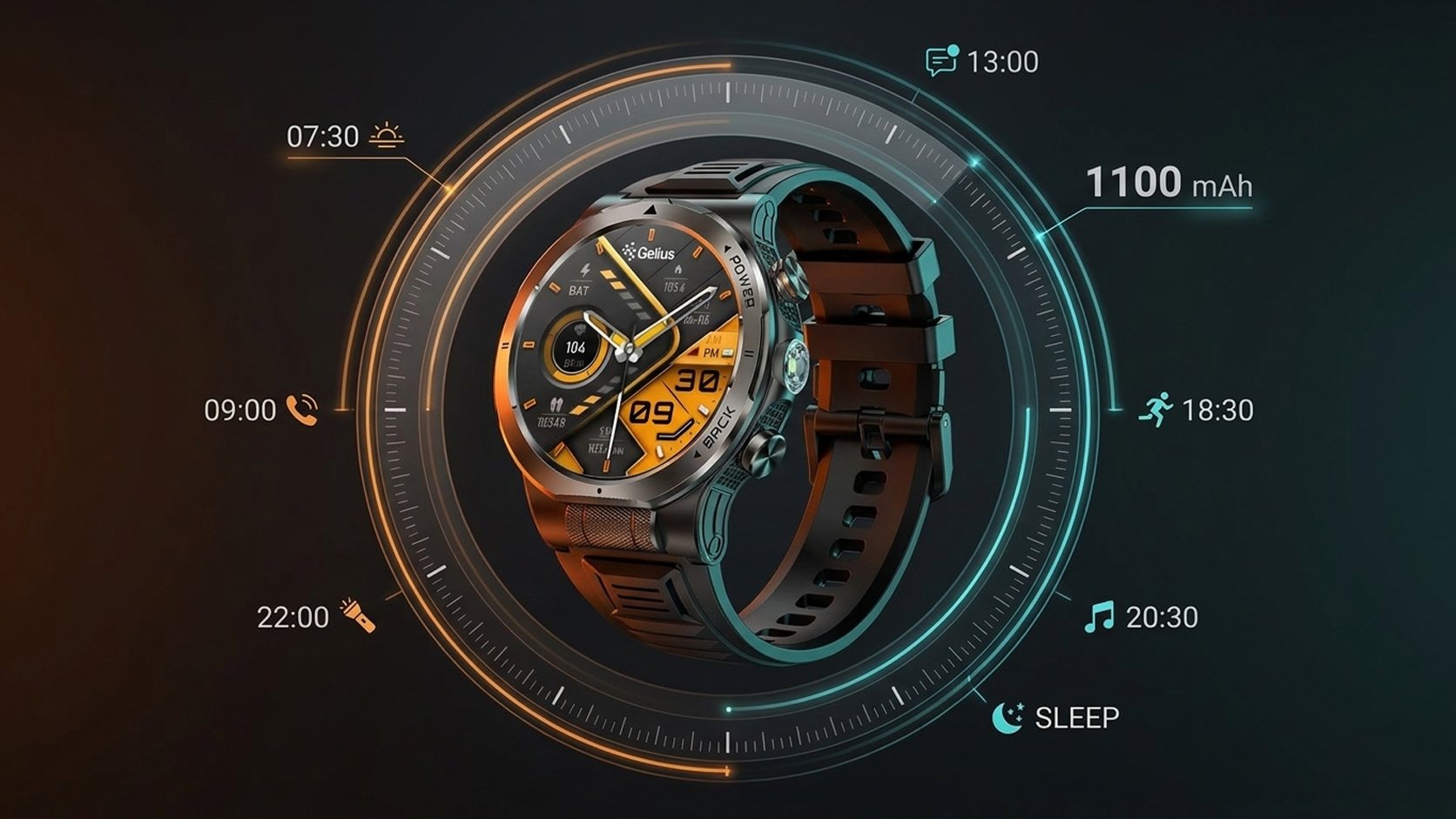
One Day in Which the Watch Works Together with You
To bring the capabilities of Amazwatch Energy together into one picture, it is enough to imagine an ordinary day.
07:30 — the morning begins.
A glance at the 1.43-inch AMOLED display — and you can check the time and available data after sleep. Thanks to Always On Display, the necessary information can remain visible without constantly activating the display.
09:00 — the workday picks up pace.
Notifications arrive on the watch. If you need to answer a call, Amazwatch Energy has a built-in microphone and speaker and supports Bluetooth calls.
13:00 — the day continues.
The watch remains on your wrist, accompanying everyday activity and providing access to smart functions without the need to pick up your smartphone every time.
18:30 — time to switch from the office to a workout.
Depending on the activity, you can use the available sports modes — for example, running, cycling, swimming, yoga, or boxing.
20:30 — a walk or the way home.
You can check the weather forecast, control music, or use other everyday functions of the watch.
22:00 — it has become dark.
The separate LED flashlight can help illuminate the path, find an item you need, or serve as an additional light source during a power outage.
In the evening — the day ends, but the watch's scenario does not.
If the user keeps Amazwatch Energy on their wrist while sleeping, the model has a sleep analysis function as part of its wellness set.
Throughout this hypothetical day, the tasks change: screen, notifications, calls, activity, workouts, music, flashlight, wellness functions.
And they are united by the characteristic with which our introduction began: the 1100 mAh battery provides the energy foundation for the large set of Amazwatch Energy functions.
Why the New Model Is Called Energy
At the beginning of our introduction to Gelius Amazwatch Energy, one number attracts the most attention — 1100 mAh.
But after getting acquainted with the model's other capabilities, it becomes clear why this energy reserve is needed here.
The watch features a 1.43-inch AMOLED display with a resolution of 466 × 466 pixels, Always On Display, Bluetooth 5.4, the ability to receive and make calls, sports and wellness functions, a digital compass, a protected case, and a separate LED flashlight.
Add to this notifications, smartphone music and camera controls, weather, timer, stopwatch, alarm clock, phone finder, 3D menu, voice assistant, and stated AI functions.
So Energy is not just a name on the box and not just a reference to battery capacity.
It is the concept of a watch in which a large energy reserve is combined with a large number of usage scenarios.
In the morning, Amazwatch Energy can show data after sleep. During the day, it can deliver notifications and help with calls. After work, it can accompany a workout. In the evening, it can control music, show the weather, or literally illuminate the path with a separate LED flashlight.
And that is why the main question here is not only how large the battery installed inside is.
What matters more is how many functions the user gets to carry together with these 1100 mAh on their wrist.
Gelius Amazwatch Energy is not built around one impressive function. Its main idea is to provide a large energy reserve for a watch whose capabilities you want to use throughout the entire day.