The New Ultra-Thin Gelius KRAZI Series Power Bank
What If a Power Bank Stopped Feeling Like a Power Bank?
A magnetic power bank is convenient right up until it turns your smartphone into a device that is too thick and heavy.
Unlike a conventional external battery, which can stay in a bag while connected to a smartphone by cable, a magnetic power bank sits directly on the back of the phone. That is why every additional millimeter of its body feels completely different.
And this is exactly where 6.5 mm becomes the defining figure of the new Gelius KRAZI series.
The 5000 mAh version is just 6.5 mm thick and weighs 105 g. Yet inside its slim aluminum body are a lithium-polymer battery, a magnetic attachment system, wireless charging up to 15 W, and Type-C with output power up to 20 W.
The power bank is built around a simple idea: having extra energy does not necessarily mean carrying a large accessory that constantly takes up space in your bag and only comes out when your smartphone battery is already critically low.
The series also includes a second model — with a capacity of 10,000 mAh. It offers a larger energy reserve but naturally has a thicker body — 12.5 mm — and weighs 165 g.
However, the main focus of this article is the ultra-thin 5000 mAh KRAZI.
What has been fitted into a body just 6.5 mm thick, and how much does this format change everyday power bank use?
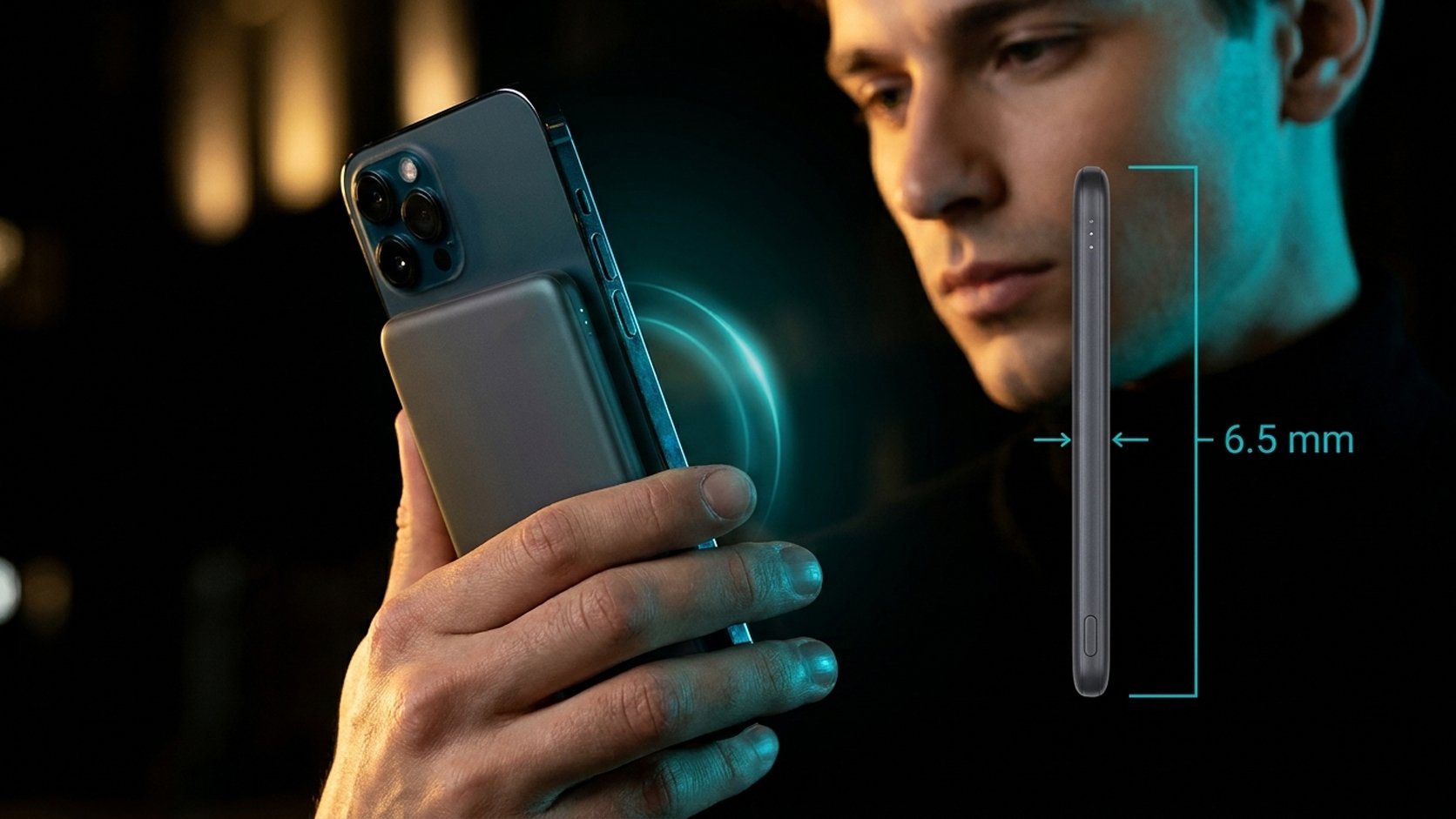
Just 6.5 mm: When a Power Bank Doesn't Make Your Smartphone Bulky
The dimensions of the 5000 mAh Gelius KRAZI series are 103.5 × 70.5 × 6.5 mm.
And it is the last figure that best explains the concept behind this model.
For a conventional power bank, thickness is not always a defining characteristic. An external battery can stay in a backpack, pocket, or bag, with a cable running to the smartphone. The user does not necessarily have to hold both devices together.
With a magnetic power bank, things are different.
It attaches directly to the back of the smartphone. During charging, two separate devices effectively become one unit. That is why the thickness and weight of the external battery become much more noticeable.
With KRAZI, the additional thickness is 6.5 mm. This helps maintain a more compact smartphone-and-power-bank combination while allowing you to continue using your phone during wireless charging.
You can check messages, open a map, answer a call, read emails, or perform other familiar tasks without having to hold a separate external battery and cable.
Of course, it would be incorrect to describe the power bank as completely unnoticeable. It weighs 105 g, and that weight is added to the smartphone.
But the main advantage of this format is not the absence of additional weight. It is the minimal added thickness and compactness of the combined setup.
This is especially important for a magnetic power bank: its dimensions are felt not somewhere inside a bag, but directly in your hand together with the smartphone.
What Fits Inside the Ultra-Thin Body
After seeing the figure of 6.5 mm, a logical question arises: how much energy can fit inside such a thin body?
Inside the Gelius KRAZI series is a 5000 mAh lithium-polymer battery.
It is important to evaluate this capacity in the context of the device's overall concept.
The 5000 mAh KRAZI is not trying to provide an enormous energy reserve for several days. Instead, the focus is on a balance between additional battery capacity and compactness.
Its intended scenario is to support your smartphone throughout a busy day when connecting to a wall outlet is either impossible or simply inconvenient.
At the same time, 5000 mAh should not automatically be translated into a specific number of full smartphone charges.
The actual amount of energy a phone receives depends on its own battery capacity, the charging method, voltage conversion, energy losses, and other conditions. This is particularly relevant to wireless energy transfer, which also involves certain losses.
Therefore, the strength of the 5000 mAh version is not a promise to fully recharge any smartphone. Its logic is different: provide an additional energy reserve throughout the day while keeping the body just 6.5 mm thick.
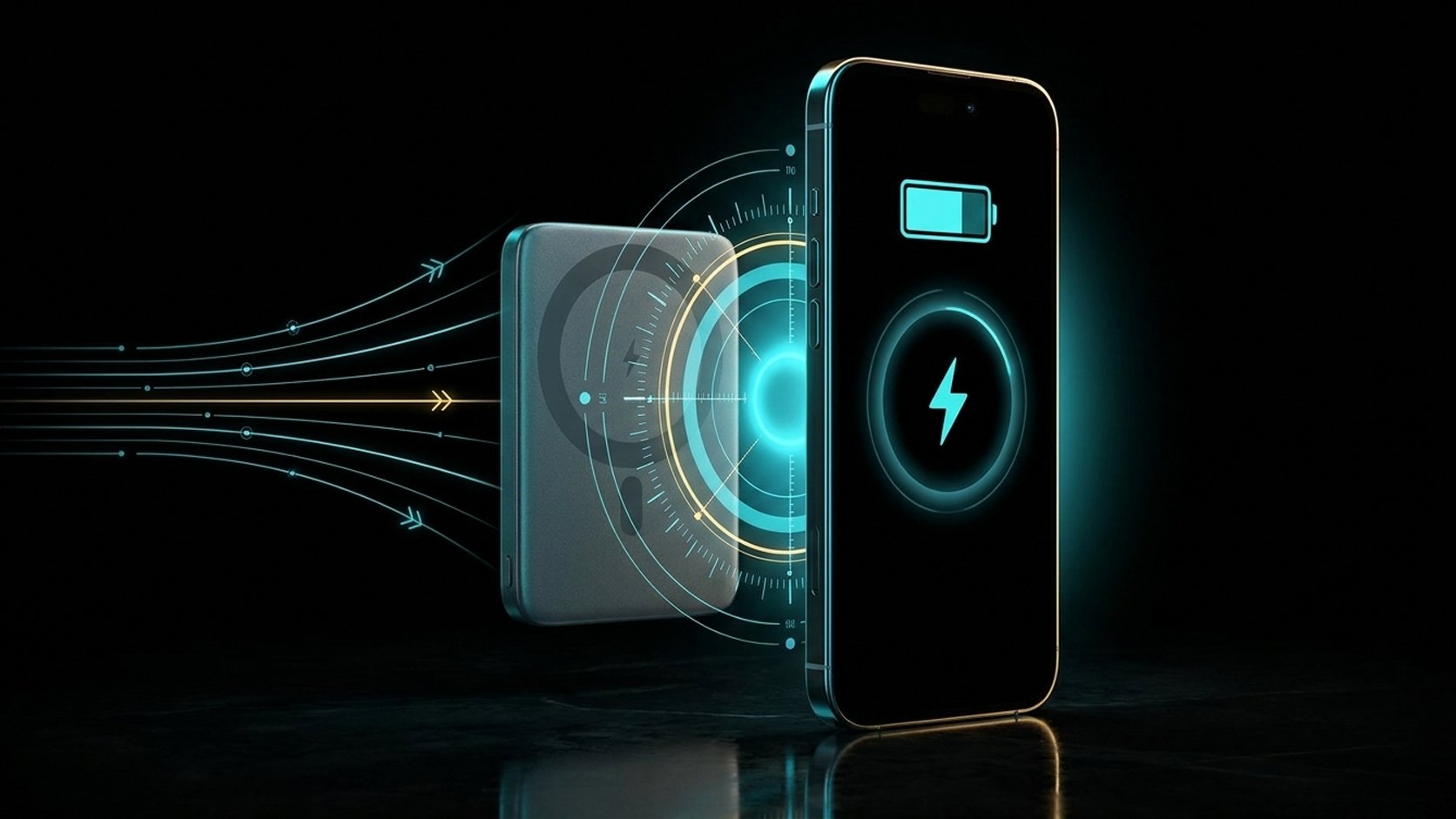
Snaps Onto Your Smartphone — and Charging Begins
Gelius KRAZI series supports magnetic attachment compatible with MagSafe.
The power bank attaches to the back of a compatible iPhone. For other smartphones, this type of use depends on having a suitable magnetic solution, such as a compatible case or ring.
The magnets serve a practical purpose: they help position the power bank correctly relative to the smartphone's charging coil.
So instead of the sequence "take out the power bank → find a cable → connect the phone," the process becomes shorter: attach the external battery to a compatible magnetic area — and wireless charging can begin.
Gelius KRAZI series supports the following wireless output modes:
- 5 W;
- 7.5 W;
- 10 W;
- up to 15 W.
However, the maximum 15 W does not mean that every iPhone or other smartphone will automatically charge at that power level. The actual mode depends on the device and the charging standard it supports.
That is why the magnetic system is particularly interesting for the way it changes the interaction: the power bank remains attached to the smartphone, and no separate cable is needed between them.
Wireless — Up to 15 W, With Type-C — Up to 20 W
Wireless charging is not the only way to receive energy from the Gelius KRAZI series.
The body includes a USB Type-C port, allowing users to choose between two scenarios depending on the situation.
Wirelessly — Up to 15 W
Wireless charging is primarily about convenience. The power bank can be magnetically attached to a compatible smartphone without connecting the two devices by cable.
The maximum stated power is up to 15 W, but the specific mode — 5, 7.5, 10, or 15 W — depends on the capabilities of the device being charged.
Via Type-C — Up to 20 W
When higher available wired output power is needed, you can switch to Type-C.
The following output parameters are specified for the 5000 mAh KRAZI version:
- 5 V / 3 A;
- 9 V / 2.22 A;
- 12 V / 1.67 A.
The maximum output power is up to 20 W. Power Delivery is also supported.
The same port is used to recharge the power bank itself. For the 5000 mAh version, the input is 5 V / 3 A — up to 15 W.
The difference between the two methods can be described simply: wireless charging is primarily about convenience and fewer cables, while Type-C offers higher available wired output power.
At the same time, it would be incorrect to promise a specific battery percentage in 30 minutes for every device. Actual charging speed depends on the smartphone model, its battery, supported protocols, and other conditions.
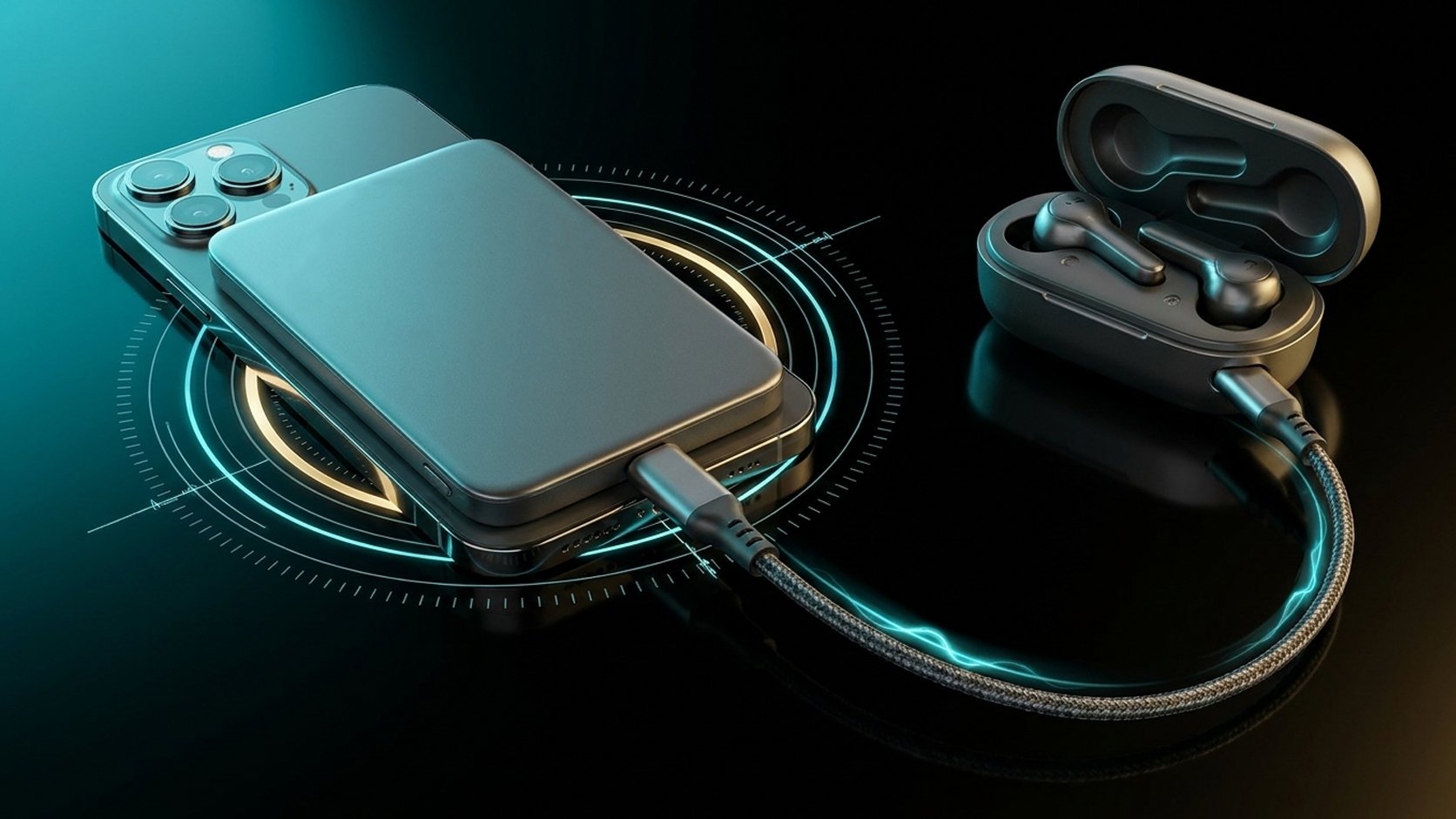
Two Devices, One Ultra-Thin Power Bank
The combination of wireless charging and Type-C gives KRAZI another practical use case — the ability to charge up to two devices.
For example, a smartphone can charge wirelessly while the power bank remains magnetically attached to its back, and a second compatible gadget can be connected via Type-C.
These could be earphones, another smartphone, or another device compatible with the relevant charging method.
This mode can be useful during the day when more than just your main smartphone needs energy.
However, the maximum values of the two outputs should not be added together to promise simultaneous 15 W + 20 W charging. The provided specifications do not include separate power distribution parameters for using both charging methods at the same time.
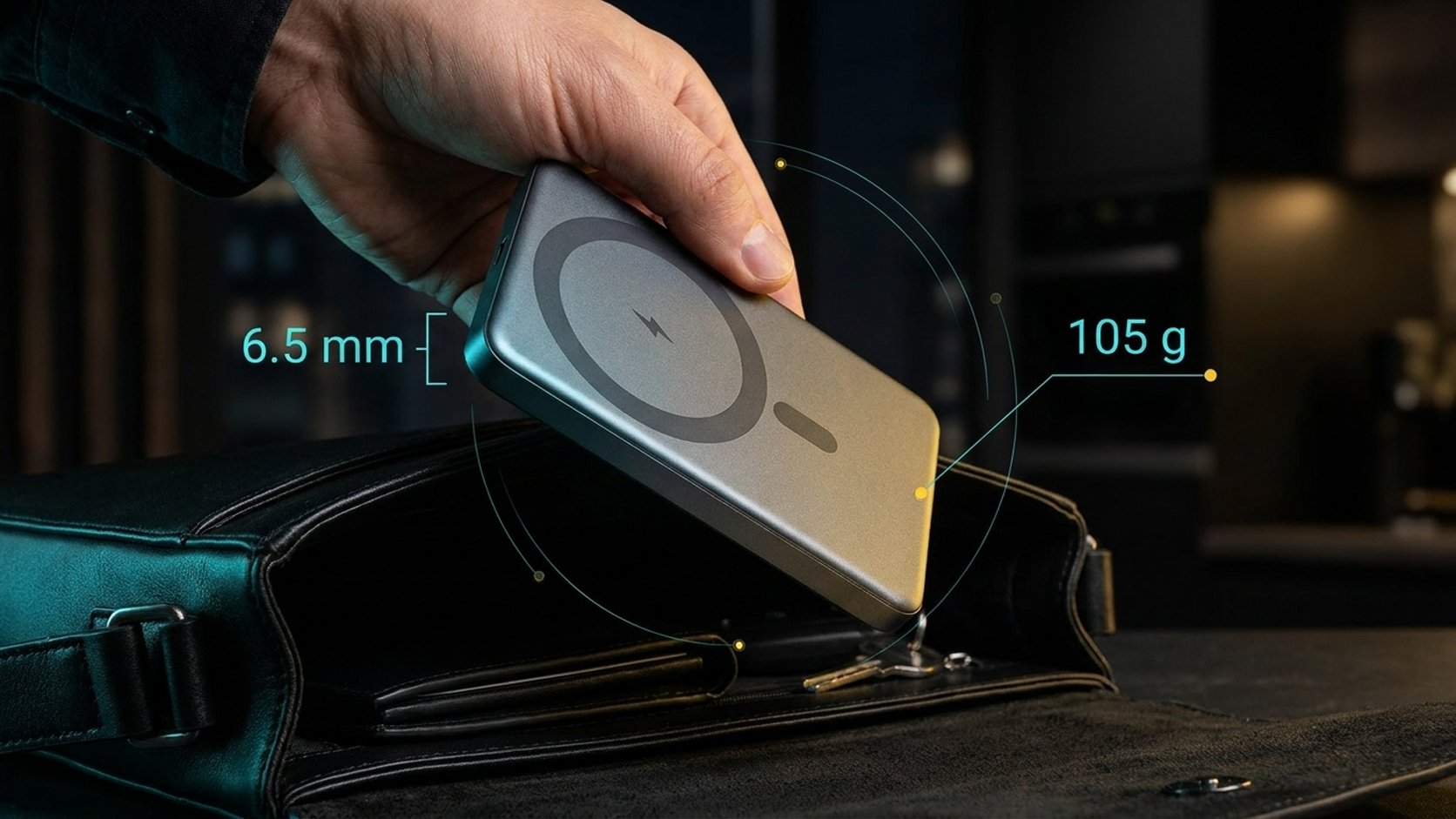
105 Grams That Are Easy to Take Along
There is one characteristic of a power bank that you will not find in a technical specification table: how often the user actually takes it along.
This is where the 105 g weight and 6.5 mm thickness begin to work together.
The 5000 mAh KRAZI fits particularly well into an ordinary busy day: commuting to work or school, meetings, cafés, walking around the city, navigation, music, calls, messaging, and photos.
By evening, your smartphone may need extra energy, but not everyone wants to carry a large power bank every day just for that possibility.
That is exactly where compact dimensions have practical value.
The 103.5 × 70.5 × 6.5 mm body does not require much space in a bag. And its 105 g weight makes it easier to add the power bank to the collection of things a user already carries throughout the day.
This does not mean it weighs nothing or cannot be felt at all. The point is that a compact external battery is easier to make a permanent part of your everyday essentials.
After all, the most useful power bank is the one that is actually with you when you need it.
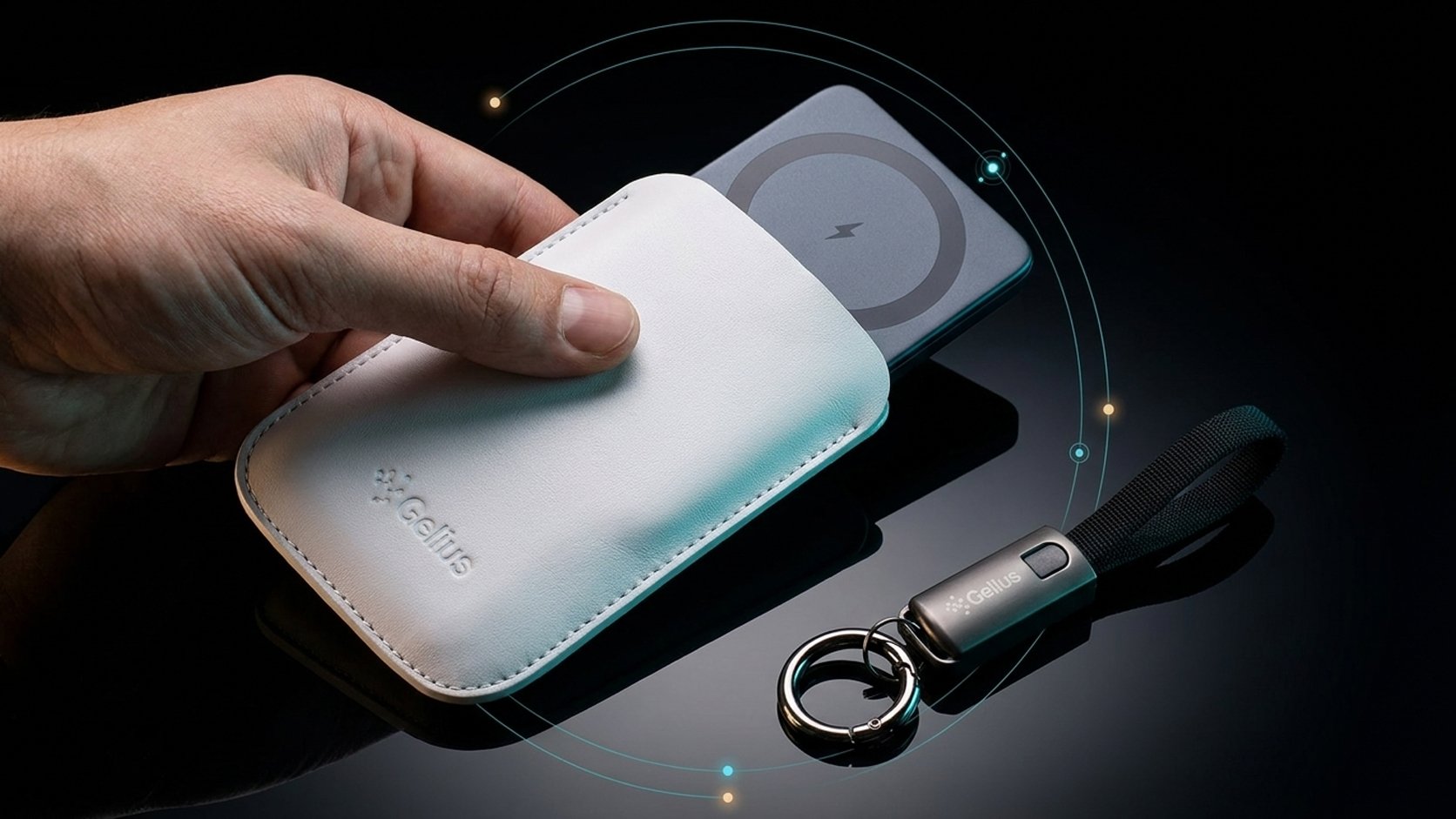
Even How to Carry KRAZI Has Been Considered
If a power bank is designed for everyday carrying, what matters is not only how it works when attached to a smartphone, but also what happens when charging is not needed.
Gelius KRAZI series comes with a separate case for storage and carrying.
You can put the power bank inside before placing it in a bag or backpack. And when your smartphone needs additional energy, simply take out KRAZI, attach it to a compatible magnetic area, and begin charging.
This naturally continues the overall logic of the product:
thin power bank → compact everyday carrying → separate case → take it out → attach it → charge.
The material of the case itself is not confirmed in the provided information, so it should not be described as leather or any other specific material.
A photograph showing the power bank partially inside its case is particularly appropriate here: it immediately explains the accessory's purpose without unnecessary text.
Aluminum Is Not Just About Appearance
The Gelius KRAZI series body is made from an aluminum alloy in the Space Graphite color.
The metal complements the overall character of the series: a slim body, a restrained graphite shade, and minimalist design.
But its role is not limited to appearance.
According to the product information, the aluminum construction helps dissipate heat and protect internal components from mechanical impact.
Heat dissipation is particularly relevant for a wireless power bank because wireless energy transfer can naturally generate heat.
That is why it would be incorrect to claim that a metal body means there will be no heating at all. Its practical role is different — the body material contributes to heat dissipation while also giving KRAZI its distinctive appearance.
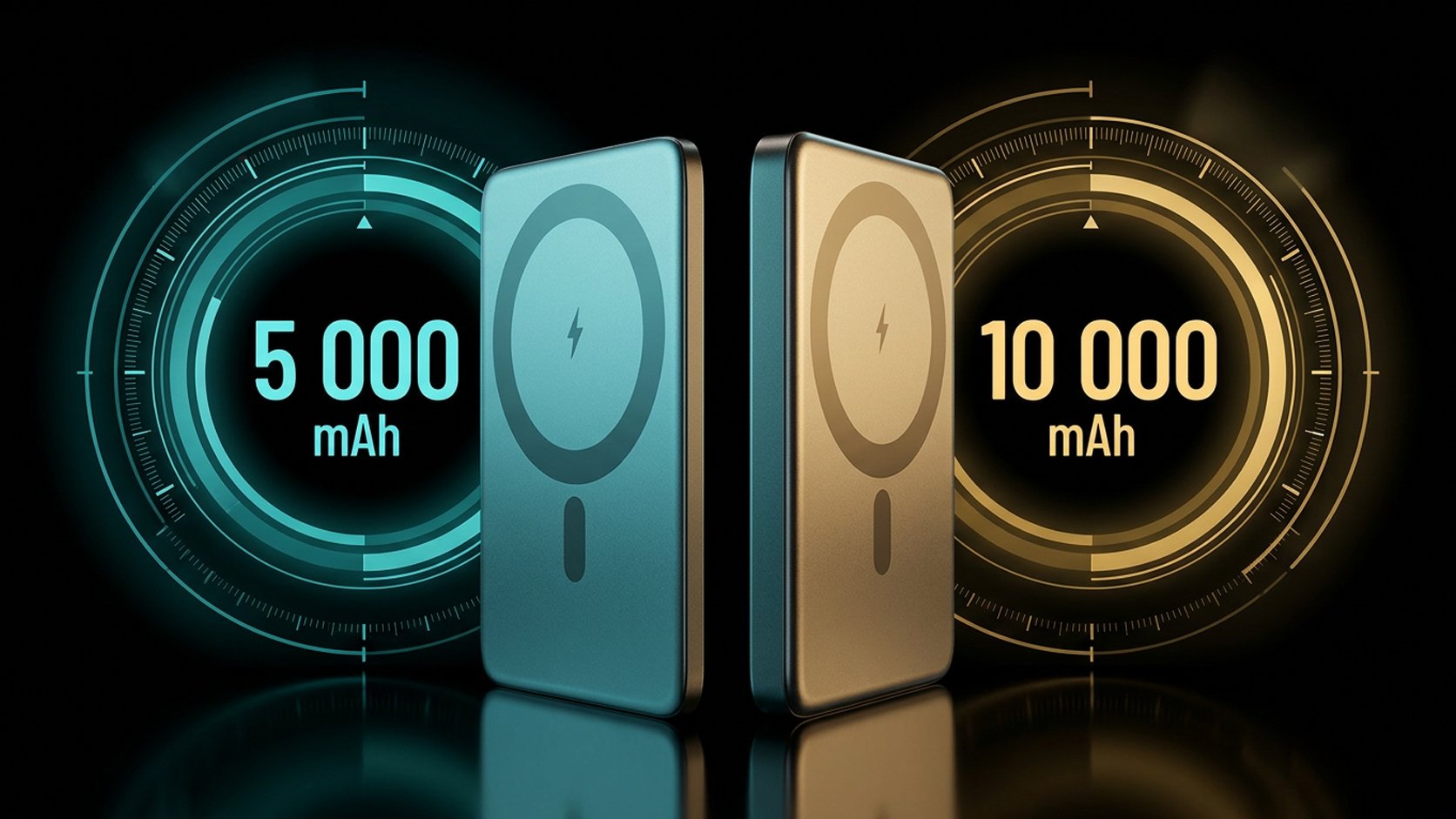
5000 or 10,000 mAh: Which Gelius KRAZI Series Should You Choose?
The Gelius KRAZI series includes two magnetic power banks. They are built around a similar concept but prioritize compactness and energy capacity differently.
Therefore, choosing between 5000 and 10,000 mAh is better approached not as a question of "which one is better," but as a simpler question: what matters more to you — minimal thickness or greater capacity?
5000 mAh: 6.5 mm and 105 g
The 5000 mAh Gelius KRAZI series version measures 103.5 × 70.5 × 6.5 mm and weighs 105 g.
This model places the greatest emphasis on compactness. Its 6.5 mm thickness helps minimize additional bulk when the power bank is magnetically attached to the back of a smartphone.
The wireless output supports 5 / 7.5 / 10 / up to 15 W modes. Type-C provides up to 20 W with Power Delivery.
This is the logical version to choose if your main requirement is: "I want to have extra energy with me every day, but I don't want to carry a large power bank."
10,000 mAh: More Energy in a 12.5 mm Body
The second Gelius KRAZI series version features a battery with a capacity of 10,000 mAh.
Its dimensions are 103.5 × 69 × 12.5 mm, and its weight is 165 g.
Compared with the 5000 mAh model, the body is therefore 6 mm thicker, and the weight increases by 60 g. In return, the nominal battery capacity doubles.
Wireless charging supports the same stated modes of 5 / 7.5 / 10 / up to 15 W, while the Type-C output provides up to 20 W with Power Delivery support.
For recharging the power bank itself via Type-C, the 10,000 mAh version supports the following input modes:
- 5 V / 3 A;
- 9 V / 2 A;
- 12 V / 1.5 A.
The body is also made from aluminum alloy in Space Graphite. A charge level indicator is included, and PCBA efficiency is stated at 85%.
This model also features a stated protection system against overcharging and critical discharge, short circuits, current overload, and overheating.
So Which KRAZI Should You Choose?
The difference between the models is clear even without complicated comparisons.
5000 mAh → 6.5 mm → 105 g — when your priority is the thinnest and lighter format for everyday carrying.
10,000 mAh → 12.5 mm → 165 g — when a larger nominal energy reserve matters more and you are willing to accept additional thickness and weight.
At the same time, both models retain the core idea of the KRAZI series: magnetic attachment, wireless charging up to 15 W, Type-C output up to 20 W with Power Delivery, and an aluminum body.
So the choice essentially comes down to a personal balance between two characteristics: how much energy you want to carry and how much additional bulk you are willing to accept for it.
Protection That Works Inside
The KRAZI body contains more than just a battery and a wireless charging module. An internal management system monitors the power delivery process.
For the 5000 mAh version, protection is stated against:
- overheating;
- short circuits;
- overcharging;
- deep discharge.
PCBA efficiency is stated at 85%.
The body also includes a charge level indicator, allowing users to monitor the power bank's remaining charge.
There is no need to go deep into the electronic circuitry here. For the user, the main thing is understanding that an internal power management system monitors the key operating parameters of the external battery.

One Day With 6.5 mm of Extra Energy
In the morning, KRAZI is sitting in its case inside a bag. The smartphone still has plenty of charge, so the power bank simply waits for its moment.
The commute to work or school. Music. Messages. Navigation. A few calls. Then meetings, messaging apps, photos, emails — and the smartphone gradually uses up its battery.
By the second half of the day, it becomes clear that the remaining charge may not last until evening.
And this is where 6.5 mm stops being just a number in a specification table.
The power bank is taken out of its case and magnetically attached to the back of a compatible smartphone. There is no need to look for a wall outlet. There is no need to hold a phone and an external battery separately while they are connected by a cable.
You can continue using your smartphone while it receives energy wirelessly.
If higher available wired output power is needed, Type-C up to 20 W with Power Delivery can be used.
After charging, KRAZI is detached from the smartphone and returned to its case.
And the next morning, it is just as easy to put it back in the bag.
This is where the practical value of 6.5 mm becomes clear: not in an impressive number on a specification sheet, but in how easily the power bank becomes one of the things you want to carry with you every day.
Who Is the Ultra-Thin Gelius KRAZI Series For?
The 5000 mAh Gelius KRAZI series version does not attempt to be an external battery for absolutely every scenario.
Its concept works best for someone who actively uses a smartphone throughout the day and wants an additional energy reserve but does not want to carry a large power bank and cable every day.
This format is particularly suitable for users who value:
- a body just 6.5 mm thick;
- a weight of 105 g;
- 5000 mAh capacity;
- magnetic attachment;
- wireless charging up to 15 W;
- Type-C output up to 20 W with Power Delivery;
- an aluminum body in Space Graphite;
- a compact format for everyday carrying.
For compatible iPhone models, magnetic attachment works thanks to MagSafe compatibility. For other smartphones, the availability of a suitable magnetic solution or ring must be taken into account.
If greater capacity is the main priority and a few extra millimeters of thickness are less critical, the same series also offers a 10,000 mAh version.
So KRAZI lets you choose not between a "good" and a "better" power bank, but between two different approaches: minimal thickness or a larger energy reserve.
When Extra Energy Shouldn't Mean Extra Bulk
6.5 mm seems like just a number until the power bank is attached directly to a smartphone.
That is when thickness begins to define the accessory's real character: how bulky the combined setup feels in your hand, how much space the external battery takes up in a bag, and whether you will even want to bring it along the next day.
The 5000 mAh Gelius KRAZI series combines a thickness of 6.5 mm, a weight of 105 g, magnetic attachment, wireless charging up to 15 W, and Type-C output up to 20 W with Power Delivery.
And if 5000 mAh is not enough for your needs, the series offers an alternative: a 10,000 mAh model that is 12.5 mm thick and weighs 165 g.
So the choice remains with the user: the thinnest possible format or a larger energy reserve.
But it is the 5000 mAh version that most accurately captures the idea behind the title of this story.
6.5 mm of energy is an attempt to turn extra battery power from a separate bulky accessory into a compact smartphone companion that is easier to carry every day.
Because extra energy does not necessarily have to mean extra bulk.