Not Just Glass: 7 Levels of Smartphone Screen Protection
Why Protective Glass Is More Than a Transparent Layer
A smartphone can spend the entire day with us without ever ending up in an extreme situation. But even an ordinary day creates plenty of risks for the display. A phone is placed in a pocket or bag, left on a table, picked up dozens of times, carried alongside other items, and sometimes accidentally dropped.
Just one contact with a hard object, an unfortunate drop, or strong mechanical stress can be enough for scratches, cracks, or other damage to appear on the display. That is why, for many people, smartphone screen protection begins with installing additional protective glass.
But there is an interesting detail: from the outside, most of these accessories look almost identical. A thin transparent surface that follows the shape of the display. So what distinguishes a simple transparent barrier from technological screen protection?
The answer lies inside the construction. Modern multi-layer protective glass can combine materials and coatings, each responsible for a separate task: resisting scratches, handling mechanical stress, maintaining transparency, providing comfortable touch interaction, keeping the surface clean, and ensuring proper adhesion to the display.
This can be clearly seen in Gelius Ultra Impact Glass. Its construction consists of seven functional levels. If we move step by step from the outer surface of the glass to the smartphone display itself, it becomes clear why each one is needed.
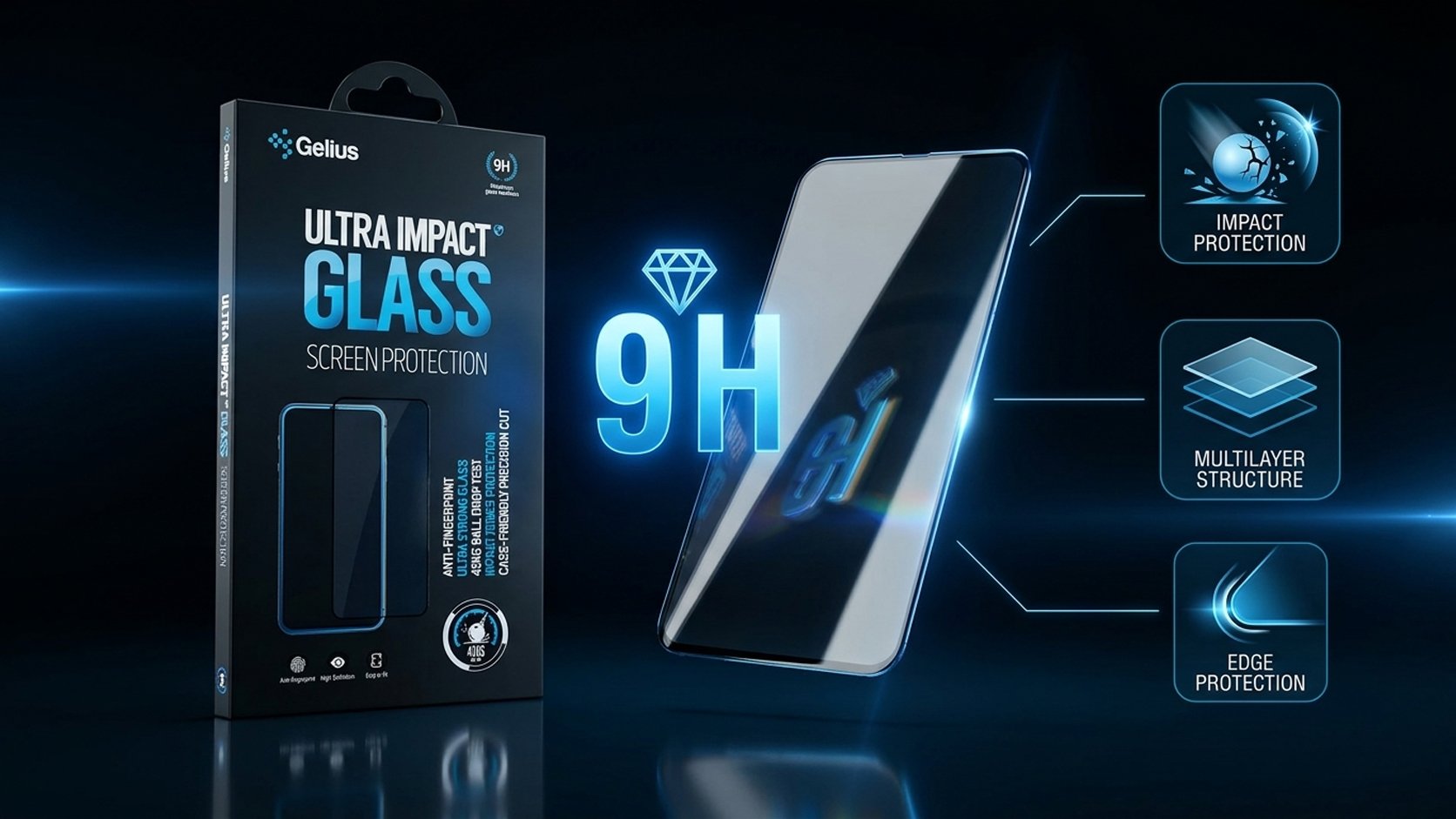
Why the 9H Rating Alone Is Not Enough
The 9H designation is one of the most noticeable specifications found in descriptions of protective glass. But what does 9H mean on protective glass in practice?
First of all, this rating describes surface hardness and its ability to resist scratches under specified conditions. For an accessory that comes into contact with different objects and surfaces every day, this is indeed an important property.
However, hardness is only one part of protection. On its own, it does not explain how the construction will behave under impact loads, how evenly it will adhere to the display, how it will affect image perception, or how comfortable the touchscreen will be to use every day.
Proper glass for screen protection needs to perform several different tasks at once:
- resist everyday scratches;
- absorb and distribute part of the mechanical load;
- adhere consistently to the display surface;
- minimize the impact on image perception;
- maintain comfortable finger glide;
- help keep the surface clean.
That is why Gelius Ultra Impact Glass uses not just one protective element, but a 7-layer structure. Each successive level complements the previous one and performs its own function.
7 Levels of Protection in Gelius Ultra Impact Glass
To understand how the multi-layer construction works, imagine moving from the surface your fingers touch every day toward the part of the glass that comes into direct contact with the smartphone display.
Level 1. 9H Hardness — Protection Against Everyday Scratches
The first layer to meet the outside environment is the enhanced 9H hardness layer. Its main task is to increase the surface's resistance to scratches that may occur during everyday smartphone use.
A phone is constantly placed on different surfaces, carried in a bag or pocket, and handled with dusty or dirty hands. The hard outer layer creates the first barrier between these factors and the main protective construction.
At the same time, 9H should not be interpreted as a promise of absolute invulnerability. The protective surface is still a physical material, and the outcome of any particular contact depends on the nature and force of the mechanical impact.
The role of the first level is therefore very specific: to increase resistance to everyday scratches, not to make the smartphone immune to every possible type of damage.
Level 2. Oleophobic Nano-Coating — Keeping the Screen Pleasant to Use
The next problem has nothing to do with drops. Just a few minutes of smartphone use are enough for fingerprints and greasy marks to appear on the surface.
This is where the oleophobic coating comes into play. It helps reduce the visibility of smudges and makes the surface easier to clean.
Gelius Ultra Impact Glass features a wear-resistant nano-coating rated for 5000+ cycles. This specification matters not only from an aesthetic perspective.
Your finger interacts with the protective glass every time you scroll through a feed, type a message, zoom in on a photo, or use an app. That is why the properties of the top surface directly affect the everyday comfort of using the display.
Level 3. Diffusion Layer — Preserving Image Quality
While physically protecting the display, it is important not to forget its primary purpose — displaying an image. Any additional material placed over the screen interacts with light, so transparency and optical properties also become part of the construction.
Gelius Ultra Impact Glass includes a diffusion layer for this purpose. Its role is related to managing light and maintaining high clarity when viewing the display.
The stated transparency of the glass is over 91%. This helps minimize the impact of the additional protective layer on image perception and color reproduction.
In other words, good protection should not only sit between the outside environment and the screen, but also remain optically transparent enough not to interfere with the primary way the smartphone is used.
Level 4. Tempered Glass — The Structural Foundation
While the previous levels are responsible for surface and optical properties, this is where the structural part of the multi-layer construction begins.
Tempered protective glass in Ultra Impact serves as the main high-strength structural element. This level forms the rigid foundation that participates in handling mechanical stress.
At the same time, a protective accessory should not be excessively bulky. It is installed directly over a touchscreen display, so thickness affects not only structural strength but also how the protection feels on the smartphone.
Gelius Ultra Impact Glass is 0.33 mm thick. In this particular construction, the thickness is selected with a balance between protective properties, touchscreen interaction, and the appearance of the device in mind.
Level 5. Shock-Absorbing Layer — Managing Impact Energy
Hardness and strength are not the only properties that matter during an impact. How the construction handles the received mechanical energy is also important.
That is why Gelius Ultra Impact Glass includes a shock-absorbing level. Its function is to help absorb and disperse part of the energy generated by strong mechanical impact.
In simple terms, during an impact, the task of a multi-layer construction is not only to remain hard. The load also needs to be received and distributed between the elements of the construction, reducing its concentration at a single point.
This is where it becomes particularly clear why evaluating protective glass solely by its 9H rating is not enough. Surface hardness primarily addresses the risk of scratches, while behavior under strong mechanical impact depends on the entire construction.
This principle also helps explain the purpose of laboratory impact testing, which we will return to in a separate section on the Ball Drop Test.
Level 6. Adhesive Layer — Why Proper Adhesion Is Also Part of Protection
You can create a complex multi-layer construction, but it still needs to sit correctly on the display. That is why the adhesive system is more than just a technical detail of the installation process.
Its purpose is to provide stable and even contact between the protective glass and the screen surface.
Gelius Ultra Impact Glass uses an antistatic adhesive system. Its antistatic properties are designed to make installation easier by reducing the attraction of small dust particles during application.
This is particularly important at the moment of installation. Even a small particle trapped between the display and the protective layer can affect the final result.
That is why the quality of adhesion should logically be considered part of the overall protection system rather than a separate issue that only matters after purchasing the glass.
Level 7. Adsorption Layer — Final Contact with the Screen
The final level is located closest to the smartphone display. The adsorption layer helps maintain the integrity of the multi-layer structure and promotes even adhesion of the protective glass.
There is no need to overcomplicate its function with technical terminology. What matters in practice is the result: all the previous layers need to work as a single construction that properly contacts the screen surface.
This completes the path from the outer 9H layer to the display. And it becomes clear that multi-layer protective glass is not one specification repeated seven times, but seven levels with different functions.
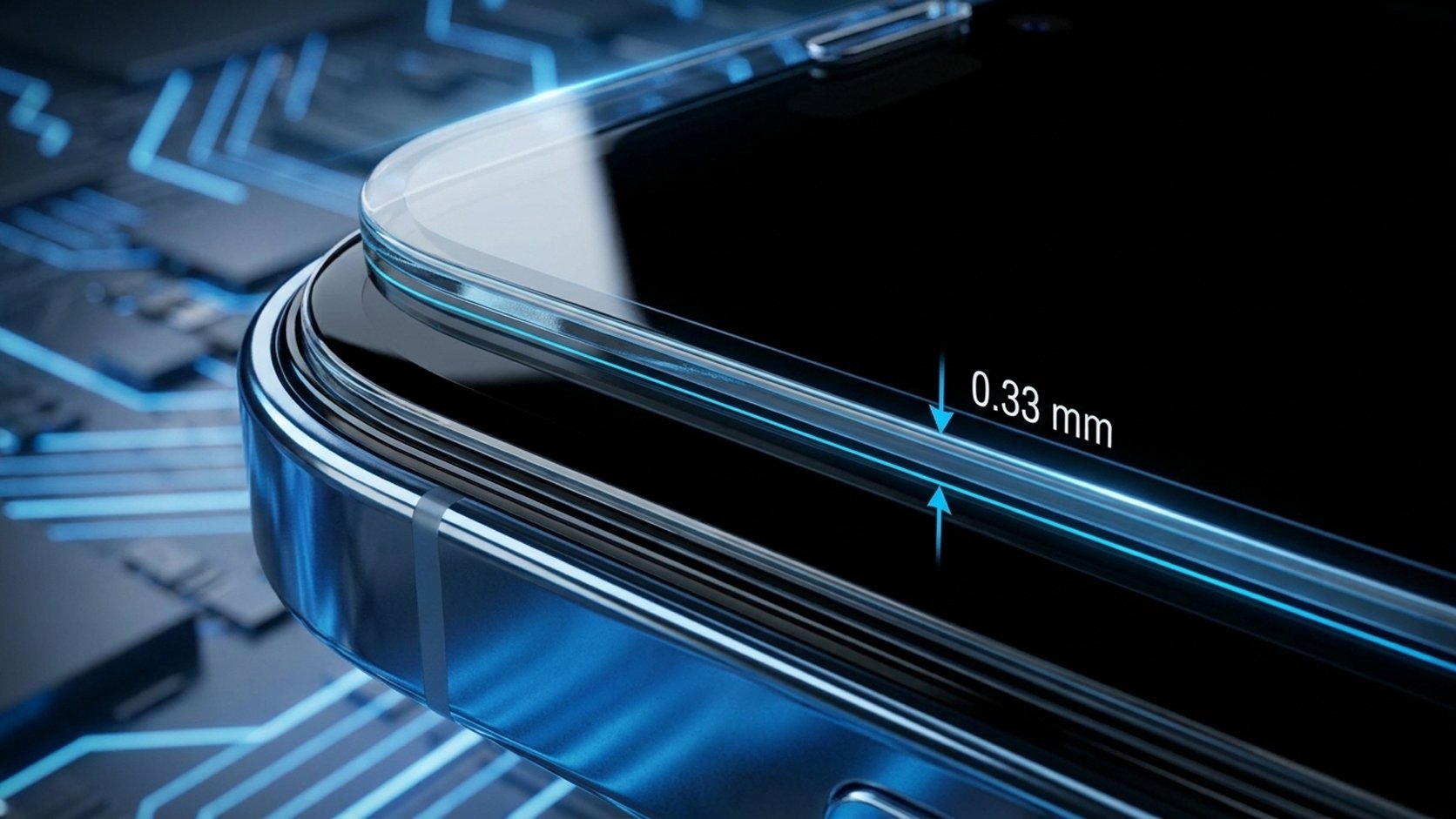
0.33 mm: Why Protective Glass Thickness Matters
The thickness of protective glass may seem like just another number in the specifications. In reality, it affects several aspects of use at once.
On the one hand, this is a physical construction that needs to perform a protective function. On the other hand, it is installed over a touchscreen that a person may use hundreds of times throughout the day.
That is why balance matters:
protection ↔ thickness ↔ touch sensitivity ↔ smartphone appearance.
Gelius Ultra Impact Glass has a thickness of 0.33 mm. In this model, this thickness is part of the overall 7-layer construction and is selected with normal touchscreen interaction in mind.
The slim profile also matters for appearance. Once installed, the protection should not turn the screen into a visually bulky separate element of the smartphone.
At the same time, it would be incorrect to make a universal conclusion that 0.33 mm is the only optimal protective glass thickness for every model. Thickness should be considered together with the materials, structure, and other characteristics of the specific product.
Not Just Impacts: Fingerprints, Water, and Dust Matter Too
When we think about how to protect a smartphone screen, the first image that often comes to mind is a drop. But most of the time, the phone is not falling — it is simply in our hands and interacting with the surrounding environment.
This is where properties that cannot be evaluated with a single strength rating become noticeable.
Oleophobic Properties: Fewer Visible Marks
Fingerprints and greasy marks constantly appear on a screen. The oleophobic nano-coating of Ultra Impact helps reduce the visibility of these marks and makes the surface easier to clean.
The coating is rated for 5000+ cycles. Therefore, glass with an oleophobic coating is worth considering not only from an aesthetic perspective but also as an element of everyday comfort.
Hydrophobic Properties: How Water Droplets Behave on the Surface
Gelius Ultra Impact Glass also has hydrophobic properties. This type of surface helps water form into droplets and roll off the glass more easily instead of spreading evenly across it.
However, a hydrophobic coating does not mean that the smartphone or the protective glass itself becomes waterproof. It refers specifically to the properties of the surface when it comes into contact with water droplets.
Metal Mesh: An Additional Barrier Around the Speaker
Another small but practical detail is the integrated metal mesh in the speaker area.
Its purpose is to create an additional barrier against dust in this area, while the construction is designed to allow sound to pass through the functional speaker area.
This is a good example of how modern smartphone screen protection can take into account not only the central part of the display but also the elements around it.
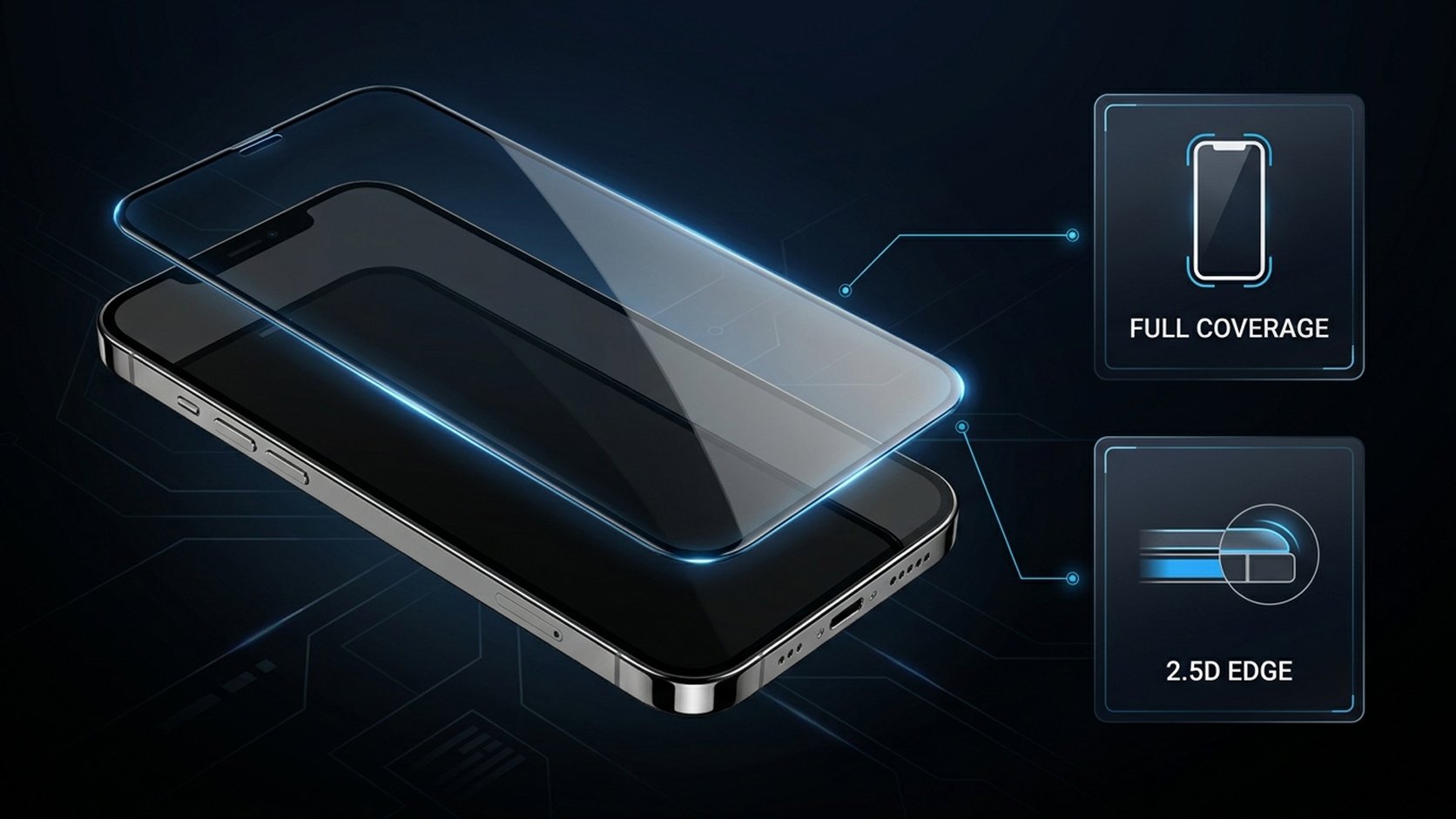
Full Coverage and 2.5D: Protection Should End Properly
Even material specifications do not provide the full picture without considering the geometry of the glass. Smartphones differ in display shape, the placement of functional areas, and edge design.
That is why precise manufacturing for a specific smartphone is important for a protective accessory.
Gelius Ultra Impact Glass uses the Full Coverage concept — complete display coverage that takes its geometry and vulnerable edge areas into account.
The edges of the glass feature 2.5D finishing. The rounded shape creates a smoother transition around the perimeter and makes the edge of the protective construction more comfortable during everyday use.
Precise geometry is also important during installation: cutouts and boundaries need to correspond to the elements of the specific smartphone model.
At the same time, full screen coverage should not be interpreted as a guarantee against damage from every side impact. The outcome of a real drop depends on many factors, including the angle of impact, the surface, the force of the impact, and the construction of the smartphone itself.
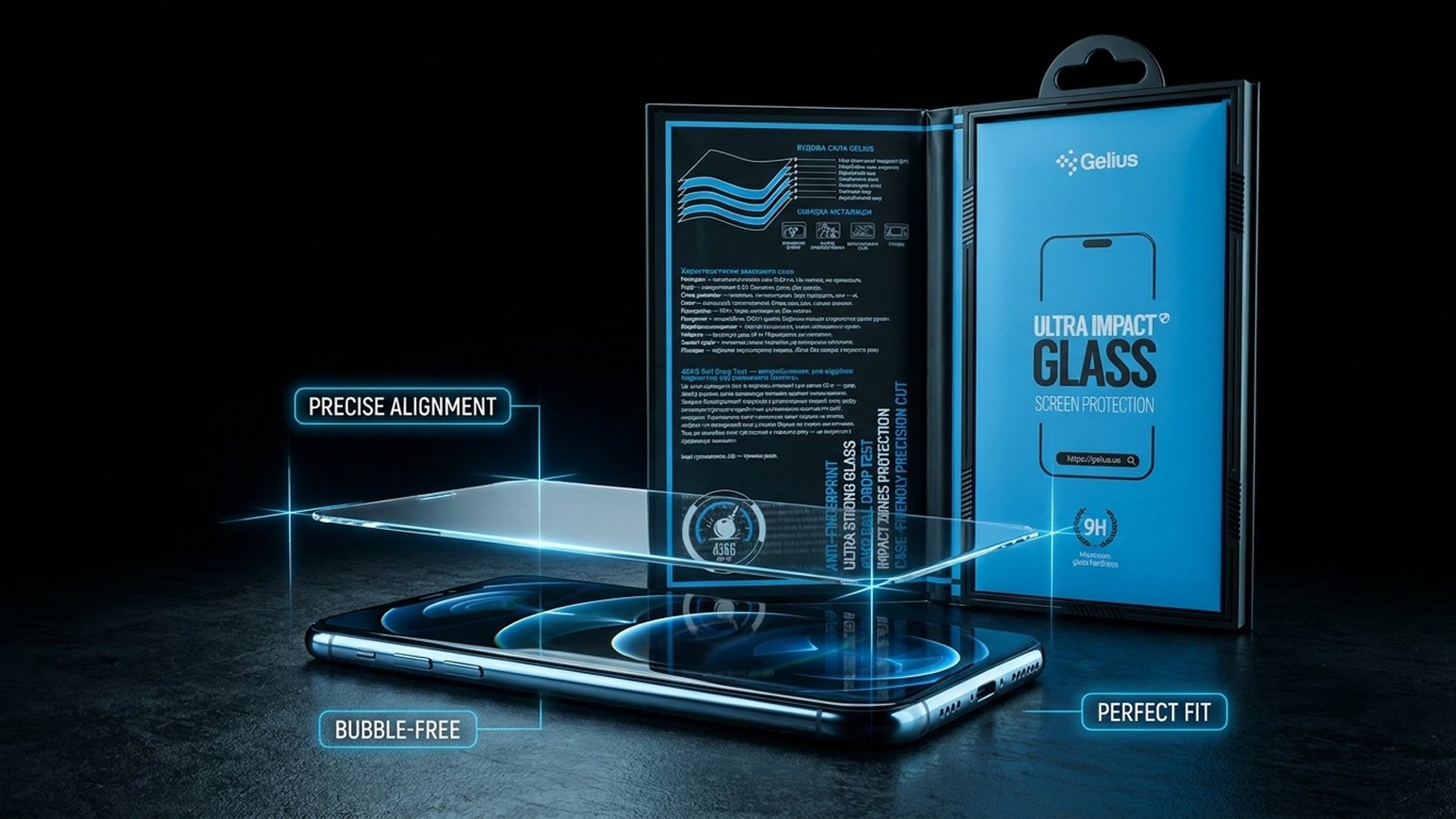
Ball Drop Test: What an Impact Test Shows
Now for a specification that sounds considerably more dramatic than thickness or transparency: Gelius Ultra Impact Glass is stated to pass a 45 kg Ball Drop Test.
But what should this type of test actually be understood to mean?
Laboratory impact tests are used to evaluate how a protective construction behaves under strong mechanical loads in controlled conditions. The material is subjected to a specified impact, and the result makes it possible to assess its ability to handle impact loads.
For Ultra Impact, the stated 45 kg Ball Drop Test demonstrates the strength of the multi-layer construction during this type of laboratory test.
This is where it is especially useful to return to the fifth level — the shock-absorbing layer. Under strong mechanical impact, the task of the construction is not only to resist through hardness, but also to absorb and distribute part of the impact energy.
That is why the Ball Drop Test is more useful to view not simply as an impressive number, but as a demonstration of why a multi-layer architecture is used in protective glass.
At the same time, a laboratory test cannot promise that a display will remain undamaged after every possible real-world drop.
A smartphone can fall flat, onto a corner, or onto an edge. It may land on wood, tile, asphalt, or another surface. The height, speed, contact angle, and construction of the device itself also vary. All these factors affect the outcome.
Therefore, the 45 kg Ball Drop Test is more accurately understood as a demonstration of the construction's strength under specified test conditions rather than a guarantee of absolute display invulnerability.
Why Proper Installation Matters Too
Even technologically advanced protective glass needs to be installed correctly. The multi-layer construction should make even contact with the display surface, while dust and dirt should not remain between the glass and the screen.
Gelius Ultra Impact Glass features an antistatic adhesive system, while the preparation process uses a cleaning kit and an antistatic film to remove dust.
The installation process itself can be divided into several consecutive steps.
- Clean the display. The surface should be thoroughly cleaned of dirt and dust particles using the cleaning kit and antistatic film.
- Remove the protective transport film. The glass should then be carefully aligned with the boundaries and functional elements of the display.
- Apply the glass. Once correctly positioned, pressing the central part starts the process of the adhesive layer bonding with the surface.
- Remove remaining air bubbles. If any remain, they can be gently pushed toward the edges by smoothing the surface.
Here again, the connection between the different levels of the construction becomes clear. The adhesive and adsorption layers can perform their functions properly only when the surface has been prepared and the glass itself has been installed evenly.
That is why installation quality is the final stage of screen protection rather than simply a formality after unpacking the accessory.
Conclusion
It is easy to evaluate protective glass by one familiar number — for example, 9H. But when you look at its construction in more detail, it becomes clear that real-world use is much more complex.
A smartphone screen needs protection from everyday scratches and mechanical stress. At the same time, users expect the additional layer not to interfere with image perception, touchscreen use, content scrolling, or keeping the surface clean.
This logic is clearly demonstrated by the 7-layer construction of Gelius Ultra Impact Glass. The outer 9H level works with scratch resistance, the oleophobic nano-coating addresses smudges and touch comfort, the diffusion layer deals with optical properties, tempered glass forms the structural foundation, and the shock-absorbing level helps manage the energy of mechanical impact.
The adhesive and adsorption layers then handle the contact between the construction and the display. Added to this are a thickness of 0.33 mm, transparency of over 91%, hydrophobic properties, 2.5D edge finishing, Full Coverage, and a metal mesh in the speaker area.
Even the 45 kg Ball Drop Test becomes easier to understand in this context: it is not a promise that the smartphone is invulnerable, but a way to demonstrate how the protective construction behaves under strong loads in controlled conditions.
Therefore, when choosing protective glass for a phone, it is worth looking beyond a single number in the specifications. Quality screen protection is a complex construction in which hardness, impact absorption, optical properties, coatings, geometry, and adhesion quality work together.
And it is precisely the combination of these details that explains why modern protective glass is much more than just a transparent layer over the display.